Hacker News and Lobste.rs are about as close to a natural experiment as you can get in online communities. They share the same format, have heavily overlapping subject matters and reach similar audiences. The only difference is their front doors: HN is wide-open, while Lobste.rs is closed, requiring an invitation from an existing member to be allowed in.
I was curious what the consequences of that one design choice are, so I spent some time this weekend comparing them.
Trying to compare the platforms wholesale is mostly meaningless due to the different topics and user volumes, so I instead matched on content: I collected a full year of submissions from both sites (2025) and looked at posts where the same URL was submitted to both platforms within 7 days of each other. That returned 8,378 matched pairs, plus their full comment trees (~325k HN comments, ~77k Lobste.rs comments). Some key takeaways:
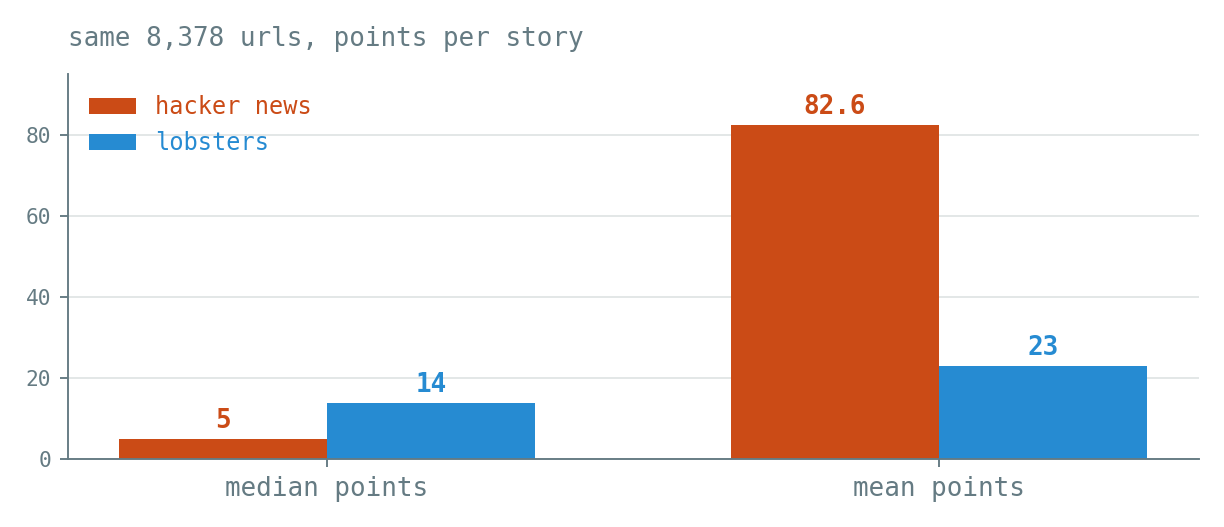
The typical story does better on Lobste.rs, the average story on HN.
The median Lobste.rs submission beats the median HN one with more than half of HN posts sinking without a single comment (compared to 3 for Lobste.rs). That's what a firehose of ~286k submissions a year does to the median post, and similar to what we see on Reddit.
Flip to means and the picture changes in an expected way with HN averaging far more points per matched story than Lobste.rs. The distributions cross with Lobste.rs winning at the low end and HN's tail extending an order of magnitude further out. HN is a lottery: most tickets lose, a few pay out enormously. Lobste.rs is closer to a guaranteed modest return.
One more engagement number I found interesting: the comment-to-score ratio is substantially higher on Lobste.rs. Relative to the attention a story gets, the invite-gated community converts more of it into actual discussion rather than drive-by upvotes.
Comment thoughtfulness is higher on Lobste.rs, but not by much
Lobste.rs comments are longer (see table 1) and a larger share of them are top-level responses to the story itself (29% vs 18%). But HN threads go deeper, though this is expected given the larger volume of users on that side.
| Hacker News | Lobste.rs | |
|---|---|---|
| Median words per comment | 41 | 51 |
| Mean words per comment | 62.0 | 80.2 |
The surprise: the invite-only site is less dominated by power users
My prior was that gatekeeping concentrates influence into an entrenched old guard. But the data disproves this. Counting all contributions across each platform for the year:
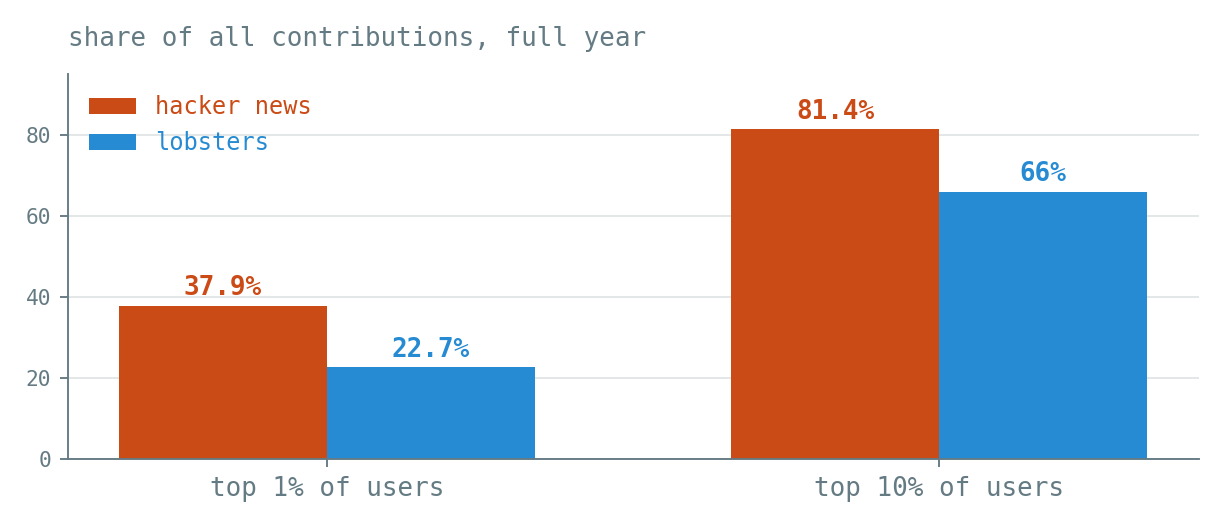
Subsampling, the results barely change. So my best guess on why this is, is that power users are found on all sites but what differs for HN is the bottom of the distribution, not the top. HN's top 1% aren't unusually prolific for a social media site, but its bottom 90% are unusually inactive.
Some takeaways
Although we can’t make any definitive causal conclusions, the association is pretty clear: an open door buys scale and viral upside at the cost of a dead median and a contributor base dominated by a small core; the invite tree buys consistent mid-level engagement and flatter participation at the cost of reach. Invite-gated communities have a reputation for elitism, but the numbers here suggest their main effect is a soft egalitarianism among those who make it inside.